Zodiac Casino Payout Percentage NZ: What the Numbers Actually Mean
Zodiac Casino publishes a site-wide return to player rate of 97.28%, independently audited across its full game library. That figure sits one to two percentage points above the 95% to 96.5% range typical for most licensed online casinos serving New Zealand players. It is the single most useful number to check before you deposit.
What RTP Actually Means
Return to player is a long-run statistical average, not a session promise. At 97.28%, the house retains approximately 2.72 cents per dollar wagered, calculated across millions of rounds. Your personal result in any one session can land anywhere on the spectrum regardless of that figure.
A certified random number generator governs every spin and hand. The RTP percentage is the audited output of those results across a full month, published so players can compare it against industry norms rather than take the casino’s word for it.
To put the gap in concrete terms: over 10,000 spins at $1 each, the difference between a 95% and a 97.28% house edge works out to roughly $228 in expected return. The maths matters at scale, even if no individual session reflects it neatly.
How the Site-Wide Figure Is Built
Every title in the library contributes to the blended 97.28% figure, but each game carries its own individual rate. The site-wide number is a weighted average: high-volume games with tight house edges pull it up, niche titles with steeper edges pull it down.
Zodiac’s weighting towards lower-margin games reflects Microgaming’s publishing standards as much as anything else. Choosing a 97% slot over a 93% slot changes your expected cost per session in a way that genuinely adds up over time.
Key fact: The 97.28% figure is verified under Zodiac’s Kahnawake Gaming Commission licence, number 00972, meaning an external regulator confirms it is not self-reported marketing copy.
The Studios Behind the Library
Microgaming is the primary software partner, supplying the large majority of slots, table games, and live casino content. The studio has been building casino software since 1994 and pushes new releases roughly every four to six weeks. Zodiac carries a curated selection rather than the full catalogue.
Microgaming’s aggregation model also pulls in content from smaller studios, including Triple Edge Studios, Just For The Win, Neon Valley Studios, All41 Studios, and Stormcraft Studios. The slot library is therefore broader than a single-provider offering, and the RTP audit covers the combined catalogue.
Slots: Named Titles and Their RTPs
The table below covers representative Microgaming-network titles available at Zodiac, showing the RTP range players can realistically expect across the library.
| Slot Title | Studio | Published RTP | Volatility |
|---|---|---|---|
| Break da Bank Again Megaways | Stormcraft Studios | 97.79% | High |
| Blood Suckers | Microgaming | 97.66% | Low-Medium |
| Avalon II | Microgaming | 97.11% | Medium |
| Immortal Romance | Microgaming | 96.86% | High |
| Thunderstruck II | Microgaming | 96.65% | Medium-High |
| Book of Oz | Triple Edge Studios | 96.50% | High |
| Jungle Jim El Dorado | Microgaming | 96.31% | Medium |
| 9 Masks of Fire | All41 Studios | 96.24% | High |
| Lucky Leprechaun | Microgaming | 96.01% | Medium |
| Mega Moolah | Microgaming | 88.12% | Medium |
Break da Bank Again Meg
Payment methods
Zodiac Payout Percentage NZ: What It Means and How to Check It Yourself
The single most useful number on any casino site is the payout percentage, and at Zodiac Casino NZ it is publicly available if you know where to look. This checklist walks you through every item you can verify yourself before putting a dollar down. Work through it in order, and you will know exactly what you are signing up for.
What Payout Percentage Actually Means
Payout percentage and return to player (RTP) are the same thing expressed differently. An RTP of 96% means the game returns $96 for every $100 wagered across millions of spins. The remaining 4% is the house edge. Neither figure tells you what happens in a single session; they describe long-run mathematical outcomes across an enormous sample size.
The house edge and RTP always add to 100%. A slot running at 95.5% RTP carries a 4.5% house edge. Live table games typically run tighter: standard European Roulette sits around 97.3% RTP (2.7% house edge), and classic Blackjack with optimal strategy can reach 99.5% RTP in some rule sets. Those numbers come from the game math, not the casino’s marketing copy.
In practice, variance also shapes your experience. A high-volatility slot like Mega Moolah can run at 88.12% RTP but still pay a life-changing jackpot to one player in a million. A low-volatility table game at 99.5% RTP grinds slowly but rarely spikes. Understanding which type suits your budget is as important as knowing the headline percentage.
How Payout Percentage Works at Zodiac: A Worked Example
Suppose you deposit $50 and play 500 spins on a slot with a stated RTP of 95%. Mathematically, the expected return across those spins is $47.50, leaving the house $2.50. In reality your session might end at $80 or at zero; the 95% figure only stabilises over hundreds of thousands of spins. This worked example is not a guarantee of any particular result.
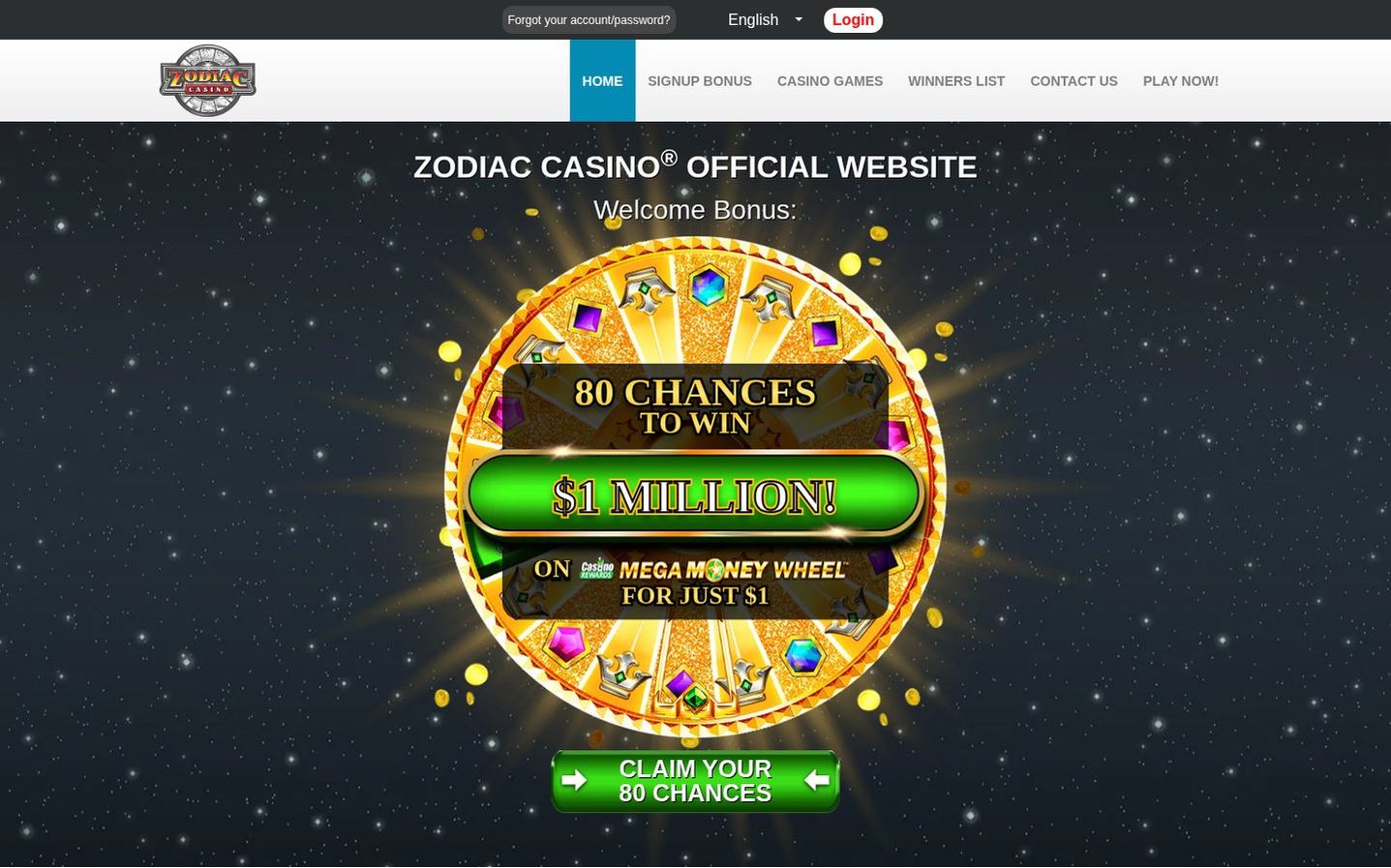
Now apply the same logic to the welcome offer: 80 chances for $1. Each chance is a spin, and the return from those 80 spins depends entirely on which game they are played on and that game’s certified RTP. Check the terms to confirm which title the spins apply to, then look up that title’s RTP in the game information panel before you play.
Heads up: Wagering requirements on any winnings from welcome spins are not confirmed in Zodiac’s publicly available summary; check the bonus terms page directly before accepting the offer, because those conditions directly affect your real return.
Your Pre-Deposit Checklist
Each item below is something you can open, find, and confirm on the Zodiac Casino NZ site right now. Tick them off in this order.
1. Confirm the Licence Number
Scroll to the footer of the Zodiac Casino homepage. The Kahnawake Gaming Commission licence, number 00972, should be displayed there. Click the licence badge if it is clickable; a legitimate regulator badge links to a verification page on the Kahnawake Gaming Commission’s own domain (kahnawake.com). If the badge does not link out, search “Kahnawake 00972” directly on the regulator’s site to cross-check.
The Kahnawake Gaming Commission has been issuing licences since 1996, making it one of the longer-running online gambling regulators in the world. It requires licensees to use certified random number generators and to publish payout percentages from independent audits. That audit requirement is what makes the RTP figures meaningful rather than arbitrary marketing claims.
2. Locate the Published Payout Percentage Report
Licensed operators under Kahnawake are required to publish regular payout reports audited by an approved third party. On Zodiac Casino NZ, look for a “Payout Report,” “Audit Report,” or “RTP Report” link, typically in the footer alongside the licence badge. Open it and check three things: the audit date, the auditing body’s name, and the overall payout percentage figure cited for the reporting period.
A report older than 12 months is worth querying with support. Reputable third-party auditors include eCOGRA and iTech Labs; the report should carry the auditor’s logo and a unique report reference number. If the report is present, dated within the past year, and carries a named auditor, that is a pass for this checklist item.
3. Check Individual Game RTPs in the Game Info Panel
Open any slot in the Zodiac game library. Before spinning, find the information or paytable button, usually a small “i” or question mark icon in the game interface. Inside, the RTP percentage should be stated. For Microgaming titles, which make up a significant portion of the Zodiac library, typical RTPs range from 88.12% (Mega Moolah) up to 97.34% (Thunderstruck II).
Other notable RTPs to look up directly: Break da Bank Again runs at 95.43%, Immortal Romance at 96.86%, and Avalon II at 97.11%. Those figures are certified by the developer, not set by the casino, so they should match the developer’s published specifications. If the in-game figure and the developer’s published figure differ by more than 0.1%, that is worth raising with support before playing.
Live table RTPs are set by the game rules, not by individual studios. Standard European Roulette carries 97.30% RTP regardless of who is dealing. Live Blackjack RTP depends on the rule variant; check the “Game Rules” or “How to Play” tab inside the live table lobby for the specific rule set in use, because rules like whether the dealer stands on soft 17 can move RTP by 0.2% or more.
4. Verify the Minimum Deposit Amount
Navigate to the cashier and confirm the minimum deposit. Zodiac Casino NZ lists a $1 minimum deposit, which is what makes the 80-chances-for-$1 welcome offer functional. The cashier should display this figure clearly before you select a payment method. If the cashier shows a different minimum for Mastercard versus Visa, note both figures.
Accepted payment methods at Zodiac are Mastercard and Visa only. Crypto is not accepted; if any third-party review site tells you otherwise, it is out of date or incorrect. Confirm in the cashier that both card brands are listed, that no additional fees are shown, and that the processing time for each is stated. Deposit processing for cards is typically immediate; withdrawal times vary and should be confirmed in the banking or FAQ section.
5. Read the Bonus Terms Before Accepting
The bonus page should state the offer clearly: 80 chances to win $1 million for a $1 deposit, with a potential bonus value up to $480. Before clicking “claim,” open the full terms and conditions linked from that page. Look specifically for: wagering requirements (the number of times you must play through the bonus), game contribution percentages (slots often count 100% while table games may count 10% or less), and any maximum cashout limit on bonus winnings.
Wagering requirements on Zodiac’s welcome offer are not confirmed in the information available for this review. Do not assume they are zero; do not assume a specific number. Read the terms yourself, note the figure, and calculate what you would need to wager before a withdrawal is permitted. That calculation directly determines your
Game providers
Zodiac Casino Payout Percentage: What 97.28% Actually Means for NZ Players
The independently audited overall payout percentage at Zodiac Casino is 97.28%, displayed in the site’s footer. That single figure is the most useful number on the page: for every $100 wagered across all games, the casino returns $97.28 to players on average, measured over millions of rounds. It does not mean you personally get $97.28 back from every session.
The gap between 97.28% and 100% is the house edge, sitting at 2.72%. That is on the lower end for online casinos, where the industry average across all game types runs closer to 4% to 5%. An independent testing laboratory measures actual outcomes across a statistically significant sample and publishes the result, so this figure is verified rather than self-reported.
RTP Basics: What the Number Actually Describes
Return to player and payout percentage mean the same thing. The percentage is calculated over the long run, typically tens of millions of spins or hands. A single hundred-spin session is statistically tiny, which is why your personal result can land well above or below 97.28% in either direction.
The house edge is simply 100% minus the RTP. A 2.72% edge is how the casino funds its operations. Knowing this number matters most when you are comparing individual games, because the blended 97.28% figure masks significant variation across the library.
Key fact: Zodiac’s 97.28% blended payout percentage sits above the online casino industry average of roughly 95% to 96%, verified by periodic third-party audit rather than internal reporting.
Per-Game RTP Across the Zodiac Library
The 97.28% figure is a blended average across slots, blackjack, roulette, video poker, and live dealer tables. Individual games carry their own RTP, and those vary considerably. Slots attract the most wagering volume and therefore carry the most weight in that blended figure.
Microgaming publishes individual RTP figures for its titles. The table below shows concrete numbers from the library rather than estimates.
| Game | Type | Published RTP |
|---|---|---|
| Jacks or Better (full-pay, optimal strategy) | Video poker | 99.54% |
| Deuces Wild (full-pay, optimal strategy) | Video poker | 100.76% |
| Avalon II | Slot | 97.07% |
| Immortal Romance | Slot | 96.86% |
| Thunderstruck II | Slot | 96.65% |
| Bridesmaids | Slot | 96.71% |
| Agent Jane Blonde Returns | Slot | 96.62% |
| Mega Moolah (base RTP, excl. jackpot) | Progressive slot | 88.12% |
Video poker sits at the top of that list for a reason. Deuces Wild’s 100.76% figure assumes optimal strategy and that the full-pay version is available. Always check the pay table before playing, because a reduced-pay variant drops that number significantly.
Live Dealer Tables: House Edges Worth Knowing
Live tables carry their own house edges, independent of the blended casino average. The numbers below are standard mathematical figures based on game rules.
| Game | Bet Type | RTP | House Edge |
|---|---|---|---|
| Live Blackjack (basic strategy) | Standard | 99.5%+ | Under 0.5% |
| Live Baccarat | Banker | 98.94% | 1.06% |
| Live Baccarat | Player | 98.76% | 1.24% |
| European Roulette | Any | 97.30% | 2.70% |
| American Roulette | Any | 94.74% | 5.26% |
| Live |
Zodiac Payout Percentage NZ: What the Numbers Actually Tell You
Zodiac Casino publishes an overall payout percentage above 97%, meaning players collectively get back more than $97 for every $100 wagered across the site over time. That figure is not a session guarantee, but it is a useful benchmark when comparing casinos. Knowing how to read it correctly changes how you approach the games.
RTP and Payout Percentage: The Core Idea
Return to player and payout percentage mean the same thing. Both express the proportion of total bets returned to players over a statistically large number of rounds. The inverse is the house edge: a 97% RTP game gives the house a 3% edge. Neither figure tells you what happens in your next spin, only what the long-run math looks like.
At a casino level, the payout percentage is an aggregate. It blends the RTPs of every slot, live table, and video poker variant on the platform. A library weighted toward low-volatility titles tends to post a higher aggregate figure, because frequent smaller wins pull the average up compared with a catalogue dominated by high-volatility slots.
Independent auditors verify Zodiac’s numbers periodically, and the results feed into the site’s transparency reporting. The Kahnawake Gaming Commission, which holds licence number 00972 for Zodiac, requires operators to maintain fair game outcomes as a condition of that licence.
How It Works in Practice
A worked example helps. Play a slot with a published RTP of 96.5%, and in theory, over an enormous number of spins, $96.50 comes back for every $100 wagered. In a single session of 200 spins at $1 each, the actual result could swing wildly in either direction, because variance compresses or stretches outcomes around that long-run mean.
Volatility is the variable RTP alone does not capture. A 96.5% RTP slot with high volatility might pay nothing for 80 spins and then land a 200x win. The same RTP with low volatility pays smaller amounts far more often. Both games sit at the same point on a payout percentage table, but the experience at the reels is completely different.
That distinction matters for bankroll planning at Zodiac, where the minimum deposit is $1. A high-volatility slot at $1 per spin will exhaust a $10 balance quickly if variance runs cold. A lower-volatility title stretches that same $10 across many more rounds and gives the published RTP more time to assert itself.
Pro tip: Check the RTP listed in a slot’s paytable before you play. Studios are required to disclose it, and knowing whether a game sits at 94% or 97% before you spin is worth sixty seconds of your time.
Game-Level RTP at Zodiac: Named Examples
The aggregate figure is shaped by individual game RTPs, so looking at specific titles gives a more useful picture than the headline number alone. Zodiac carries games from Microgaming, one of the longest-running software studios in the industry, with hundreds of slots and individually published RTPs. Several titles are worth knowing by name.
| Game | Studio | Published RTP | Volatility |
|---|---|---|---|
| Mega Moolah | Microgaming | 88.12% (base) | High |
| Thunderstruck II | Microgaming | 96.65% | Medium-High |
| Immortal Romance | Microgaming | 96.86% | High |
Mega Moolah
Mega Moolah carries a base RTP of 88.12%, lower than the site average because a portion of every bet feeds the progressive jackpot pool. When the jackpot is factored in, the effective RTP climbs, but how much depends on the jackpot’s current size and seeding history. The game has paid out jackpots worth millions of dollars across its lifetime.
For a $1 minimum deposit player at Zodiac NZ, Mega Moolah sits at the higher-risk end of the spectrum. On non-jackpot rounds the math is less favourable than most Microgaming table games. Players chasing the progressive accept that trade-off knowingly.
Thunderstruck II
Thunderstruck II publishes an RTP of 96.65%, sitting comfortably above the typical industry midpoint. It runs at medium-to-high volatility, so wins come less often than in a low-variance title but tend to be larger when they land. The Great Hall of Spins bonus drives much of that variance, with four distinct free-spin modes that unlock progressively as you accumulate triggering scatters.
Players who want a title where the published RTP and session results are likely to converge over 300 to 500 spins will find Thunderstruck II a more predictable choice than Mega Moolah. A meaningful share of Zodiac’s play volume flowing through mid-to-high RTP slots like this one is what keeps the site-level average above 97%.
Zodiac Casino Payout Percentage: What NZ Players Actually Need to Know
The payout percentage is the single most useful number for gauging how much any game costs to play over time. It tells you, across millions of rounds, how many cents of every dollar wagered come back to players as winnings. The rest is the house edge. Neither figure promises anything about your session tonight, but together they are the best objective measure of a game’s long-run cost.
Zodiac Casino publishes an overall casino payout percentage, which is a weighted average across every game on the platform. It covers slots, live tables, video poker, and specialty games at once. Because slots attract the highest wagering volume on most platforms, they pull the casino-wide figure closer to their own average than any other category does.
How RTP Is Actually Calculated
Return to player is calculated by dividing total money returned to players by total money wagered, across a statistically significant number of rounds. A slot with 96.00% RTP returns $96 for every $100 wagered in aggregate. The remaining $4 is the house edge. That figure emerges from tens of millions of spins, not from a single session.
Each game’s RTP is set by the software studio during development and verified by an independent testing laboratory before the title goes live. Microgaming, which supplies the majority of titles at Zodiac, uses laboratories such as eCOGRA to audit those figures. The certified results are what get reported to the licensing authority that holds Zodiac’s licence.
The casino-wide payout percentage aggregates every individual game’s RTP, weighted by how much real money was wagered on each game during a reporting period. A game with $500,000 wagered has five times the influence on the overall figure as one with $100,000 wagered, even if both share the same RTP. That weighting is why the casino-wide figure shifts slightly from month to month.
RTP, House Edge, and Variance: Three Different Things
RTP and house edge are two sides of the same number. A game with 96.50% RTP carries a house edge of 3.50%; one with 94.00% RTP carries a house edge of 6.00%. The lower the RTP, the more the game costs per dollar wagered on average. These are mathematical constants built into the game engine, not settings a casino adjusts.
Variance, sometimes called volatility, is separate. It describes how the available RTP is distributed over time. A high-variance slot like Mega Moolah may pay 96% RTP in aggregate, but deliver most of that through rare, very large jackpot hits. Between those hits, most sessions return far less. A low-variance title distributes returns more evenly but rarely produces life-changing wins.
Both numbers matter together. A high-RTP, high-variance slot and a high-RTP, low-variance slot look identical on a game information page but play completely differently. RTP tells you the long-run cost; variance tells you what the distribution of outcomes looks like. Short sessions on high-variance games carry more risk than the RTP figure alone suggests.
What These Numbers Look Like on Specific Zodiac Titles
Microgaming publishes individual RTP figures in each game’s help file. The examples below illustrate the range players actually encounter at Zodiac.
| Game | Studio | Category | RTP | Variance |
|---|---|---|---|---|
| Mega Moolah | Microgaming | Progressive Slot | 88.12% | High |
| Thunderstruck II | Microgaming | Video Slot | 96.65% | Medium-High |
| Break Da Bank Again | Microgaming | Video Slot | 95.43% | Low-Medium |
| Immortal Romance | Microgaming | Video Slot | 96.86% | High |
| European Roulette Gold | Microgaming | Table Game | 97.30% | Low |
| Blackjack Gold | Microgaming | Table Game | 99.60% | Low |
| Jacks or Better | Microgaming | Video Poker | 99.54% | Low-Medium |
The spread here is significant. Blackjack Gold at 99.60%
Zodiac Casino NZ Payout Percentage: RTP Explained for New Zealand Players
What Payout Percentage Actually Means
Return to player (RTP) is the percentage of all money wagered that a game pays back over a very large number of rounds. A slot with 96% RTP theoretically returns $96 for every $100 wagered across its full statistical lifetime. The remaining 4% is the house edge.
That figure is calculated over millions of spins, not a single afternoon. Any individual session can finish well above or well below the stated RTP, so treat it as a long-run average rather than a personal guarantee.
How RTP Works at Zodiac Casino NZ
Games at Zodiac are supplied primarily by Microgaming, a studio with over two decades of independently audited titles. Accredited testing laboratories verify every RTP figure before a game goes live, and the results appear in each title’s paytable or help screen.
Finding the number takes about ten seconds: load the game, tap the information icon, and search for “return to player.” That one habit removes any guesswork before you commit real money to a session.
Pro tip: Always check the help screen of a Microgaming slot before you spin. The published RTP is listed there for every title, and it tells you instantly whether that game suits your budget and risk tolerance.
Typical RTP Ranges Across Game Categories at Zodiac NZ
Different game types carry meaningfully different RTP ranges. The table below covers the main categories available at Zodiac, based on published Microgaming data.
| Game Category | Typical RTP Range | Notes |
|---|---|---|
| Video slots | 94% to 97% | Varies by title; check individual paytable |
| Classic slots | 95% to 97% | Generally tighter variance than video slots |
| Progressive jackpot slots | 88% to 94% | Lower base RTP funds the jackpot pool |
| Video poker | 96% to 99.5% | Highest RTP when optimal strategy is applied |
| Blackjack | 99% to 99.5% | Assumes basic strategy; side bets reduce RTP |
| Roulette (European) | 97.3% | Single-zero wheel; fixed across all stakes |
| Roulette (American) | 94.7% | Double-zero wheel; materially lower RTP |
| Live dealer tables | 96% to 99% | Depends on game variant and side bets chosen |
The starkest gap in that table is between European and American roulette. A 2.6 percentage point difference, explained entirely by the extra double-zero pocket on the American wheel, compounds noticeably over a long session. New Zealand players who enjoy roulette are better served by the European version whenever it is available.
Progressive Jackpots and Why Their RTP Looks Lower
Zodiac carries Microgaming’s progressive jackpot network, including Mega Moolah, Mega Moolah Isis, and Major Millions. Mega Moolah holds a Guinness World Record for the largest online jackpot payout and has paid out over $1 billion across its lifetime.
Mega Moolah’s base game RTP sits at 88.12%. That figure is lower than most video slots because a portion of every spin feeds the Mega, Major, Minor, and Mini jackpot pools rather than the base game return. The effective RTP rises once you factor in the expected value of the progressive pool, but that contribution only materialises if the jackpot wheel triggers for you.
A player who never lands the wheel trigger will experience returns closer to the 88% base figure. That is the honest trade-off: you accept a lower guaranteed return for exposure to a life-changing top prize. Which suits you depends on the kind of session you want.
A Worked Example: RTP in Practice
Take a video slot with a published RTP of 96.5% and a session budget of $200. The theoretical expected loss is $200 multiplied by 3.5%, which equals $7. In practice, the outcome could be a total loss or a win many times the starting amount.
That $7 is the mathematical expectation averaged across an enormous sample, not a prediction for your afternoon. Variance determines how bumpy the ride feels. High-variance titles like Immortal Romance (RTP 96.86%) produce infrequent but large wins, while medium-variance titles like Thunderstruck II (RTP 96.65%) pay smaller amounts more regularly.
Understanding variance alongside RTP gives a more complete picture than either
Inside Zodiac